
269.26 KB
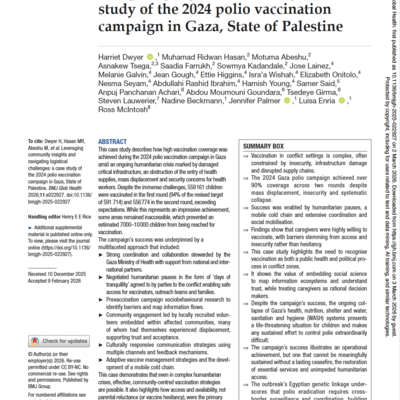
When polio re-emerged in Gaza in 2024 after 25 years polio-free, the campaign that followed achieved over 90% coverage across two rounds — vaccinating more than 559,000 children in Round 1 and 556,000 in Round 2, in the middle of active conflict, mass displacement, and the near-total collapse of Gaza's health system. A new BMJ Global Health case study by UNICEF, AWRAD, and LSHTM authors unpacks how it was done — and challenges some long-standing assumptions about vaccine hesitancy along the way.
The headline finding for SBC practitioners: access and availability — not parental reluctance — were the primary constraints on coverage. 94% of caregivers surveyed said they would vaccinate their children if they could. The barriers were damaged facilities, displacement, insecurity, and disrupted information channels. Where services reached families, families showed up.
What enabled the campaign to work:
- Negotiated humanitarian pauses ("days of tranquillity") secured through sustained political and diplomatic engagement, including cross-border public health advocacy
- Pre-campaign sociobehavioural research to map the information ecosystem and surface real (vs. assumed) barriers
- 700+ locally recruited community mobilisers, many themselves displaced, conducting tent-to-tent visits — over 750,000 household visits and 1.2 million community engagements across the two rounds
- A built-from-scratch mobile cold chain (20 fridges, 10 freezers, 800 vaccine carriers, 2 refrigerated trucks) after assessment found less than 25% of the existing cold chain operational
- Multichannel communication combining SMS, WhatsApp, social media influencers (combined reach 2M+), megaphones, and face-to-face dialogue — with a feedback hotline to close the loop
Why this matters beyond Gaza: the paper reframes a narrative that often dominates outbreak response discourse. Caregiver concerns about vaccine quality or origin in Gaza were not "hesitancy" or "misinformation" — they were rational, politically-informed responses to systemic collapse. The authors argue for treating parents in conflict settings as active, protective decision-makers and building on pre-existing acceptance cultures rather than defaulting to hesitancy framings.
Practical takeaways for SBC teams working in conflict and humanitarian settings:
- Map the information ecosystem before designing messaging
- Embed social science research longitudinally, not just at baseline
- Invest in relational trust through embedded local mobilisers — institutional trust often won't carry the campaign
- Recognise vaccination as both a public health and political process; humanitarian pauses require diplomacy as much as logistics