
3.2 MB
Somalia ended wild poliovirus transmission in 2014, but circulating variant poliovirus type 2 (cVDPV2) remains a persistent threat — driven by low routine immunization, ~1.5 million zero-dose children, conflict, climate shocks, and large nomadic and displaced populations. In 2025, the Federal Ministry of Health, UNICEF, and GPEI partners ran four polio rounds vaccinating up to 2.5 million children per round, alongside an integrated SBC strategy designed to reach the children traditional approaches were missing.
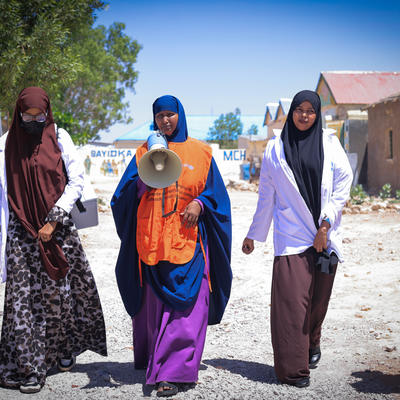
This case study documents how three workstreams — the Big Catch-Up (BCU), the Influential Leaders Project, and integrated polio campaigns — were combined into a single complementary system for identifying and vaccinating missed children. Anchored in Human-Centred Design, the Influential Leaders Project trained 1,090 elders, women, and youth leaders across 17 high-risk districts to co-create defaulter tracking tools and messaging. Working alongside the long-standing Social Mobilization Network (SOMNET, ~6,000 mobilizers) and the National Islamic Advisory Group (NIAG), influential leaders helped trace 39,144 zero-dose and defaulter children in just four months — with 97.9% subsequently vaccinated. Across all platforms in 2025, 80,658 zero-dose children were traced and 79,371 vaccinated. The service-delivery component also supported 100 health facilities, reopened 38, and reached 138 villages with routine services for the first time.
Key lessons highlight that community ownership, trust-building, real-time data (IVR tools, ODK), and partnerships across WHO, WFP, FAO, CDC, Gavi, the Gates Foundation, and telecoms are what make integrated polio SBC work in one of the world's most challenging environments. The study closes with recommendations on scaling the Influential Leaders Project to 56 new districts, strengthening cross-border collaboration, securing sustainable financing, and institutionalising digital tools within Ministry of Health systems.